How to Choose a Static-Control Hose
flexED Knowledge Base
11/17/2026

How to Choose a Static-Control Hose
What to ask for at the counter and what to verify once the fittings are on.
An old vacuum hose comes back to the shop with worn ends and a request to reuse the couplings. The customer knows which truck it came off, how much hose fits on the rack and when the crew needs it back. The old label is gone. On a busy day, it would be easy to quote by diameter, length and vacuum rating and send a look-alike back out.
On a job with a static-control requirement, that leaves an important part of the order open. The original hose may have used a wire connected to the fittings, a static-dissipating lining, or both. The replacement can fit the truck and hold vacuum while its intended electrical path is open. You find out by checking the finished assembly, and that check starts with knowing what the job calls for.
Quick Answer
Choose a static-control hose by starting with the job’s electrical requirement. Find out which parts must be connected, what method the shop should use to test them and what resistance is acceptable. Then choose a hose and fittings that also suit the material, temperature and vacuum or pressure. Have the shop test the finished assembly and the crew verify its connections at installation. [1]
What to Ask Before You Order
At the counter, “static hose” is the beginning of a conversation. It can mean the buyer needs a hose that meets a written electrical specification, or that a crew has felt shocks and wants someone to look at the setup. Ask what prompted the request. If there’s an existing specification, get it before quoting. If the requirement came from a concern in the field, get the application details to the person who can evaluate the operation. A replacement order is a good point to catch that difference.
Start with what goes through the hose
A vacuum truck can spend the morning picking up wet grit and the afternoon on a job with fine dry powder. The same inlet and hose diameter tell you very little about what the powder can do when it’s dispersed into air. The field contact may describe it as housekeeping material. The site may know it as a particular process dust, with its own collection requirements. Ask for the material name and the site’s approved equipment for that service. If there’s a mixture or the material changes across jobs, say so up front. [2] [3]
The distinction matters with liquids too. The material in the hose and the atmosphere around the operation are two separate things to describe. In a flammable-liquid transfer, vapor near an opening can be part of the hazard the site is managing. On a vacuum job, the facility needs to consider the truck or vacuum unit, where the material goes, the hose and what’s attached to it. Each component has a place in that assessment. [4] [5]
A useful handoff sounds like something the next person can act on. “We’re replacing a hose on Truck 12 for the same approved dry recovery job. Here’s the site document the original was built to.” If the hose is going from wet cleanup to an unfamiliar material, flag the change and have the site establish the requirements for that use. Getting a replacement to fit is a much smaller problem than establishing what service it can go into.
Ask for the test points
Once the customer identifies the requirement, ask where the shop is meant to measure. On one job, it might be from the metal fitting at one end to the fitting at the other. On another, the inside lining needs an electrical connection to a fitting as well. Get the required test method and acceptance limit in writing. If a quotation calls out “electrical continuity” on its own, send it back with a specific question about which path is covered. [1]
The buyer should also know whether they’re getting bulk hose or an assembly. A hose manufacturer can describe the construction and electrical properties of the hose it makes. The shop that installs the fittings has to deliver the specified electrical performance of the assembly it builds. The crew is responsible for checking the connections its procedure calls for after that assembly goes into the system. Putting those responsibilities on the order saves a conversation at the loading dock. [1] [6]
A Replacement Hose at the Counter
Say an industrial vacuum crew brings in a 4-inch hose assembly. It needs to go back on a truck assigned to a dry material recovery job the site has already evaluated. The shop finds two abrasion-resistant hoses that fit the dimensions and vacuum requirement. Both use a static-dissipating rubber compound. One also has a copper wire. The old assembly is worn enough that the hose marking is hard to read.
The customer pulls up the site spec. It calls for a grounding wire connected to both metal end fittings and an end-to-end resistance measurement on the finished assembly. The last order also specifies the coupling and the acceptance limit. That tells the shop which of the two constructions to quote. It checks the old fittings for condition and compatibility with the new hose before deciding whether to reuse them. Matching the truck connection is only one part of that decision. [7] [8] [6]
What the shop hands back
The shop’s work order names the hose model, size and length, the specified end fittings and the way the manufacturer calls for the wire to be connected. The test record identifies the assembly, says that the measurement was taken between the two metal fittings and gives the result against the site’s limit. If the order also requires a lining-to-fitting measurement, the shop records that on its own line. A generic “continuity checked” entry leaves out information the buyer now knows to ask for. [1] [6]
That record comes in handy the first time this hose is recoupled. A technician can see which points were tested when the assembly left the shop and which spec it was built to. If the customer calls with a question six months later, the distributor can pull up one assembly, even if the same truck runs several hoses of the same diameter.
What the crew still checks
At the truck, the crew couples the new hose to the approved setup and checks the connections the site calls for. Suppose the operator has added an extension and changed the pickup wand since the old assembly came off. The shop’s record describes the piece it delivered. The connection through the extension and to the wand belongs to the installation check. Staff can use the test record and the site procedure together to establish what they have in the field. [1] [2] [6]
There’s a good reason to describe those checks separately on a work order. Both people can truthfully say they checked the hose. One checked a particular assembly on a bench. The other checked the installed equipment. When the test locations are written down, the supplier and crew know what each result covers.
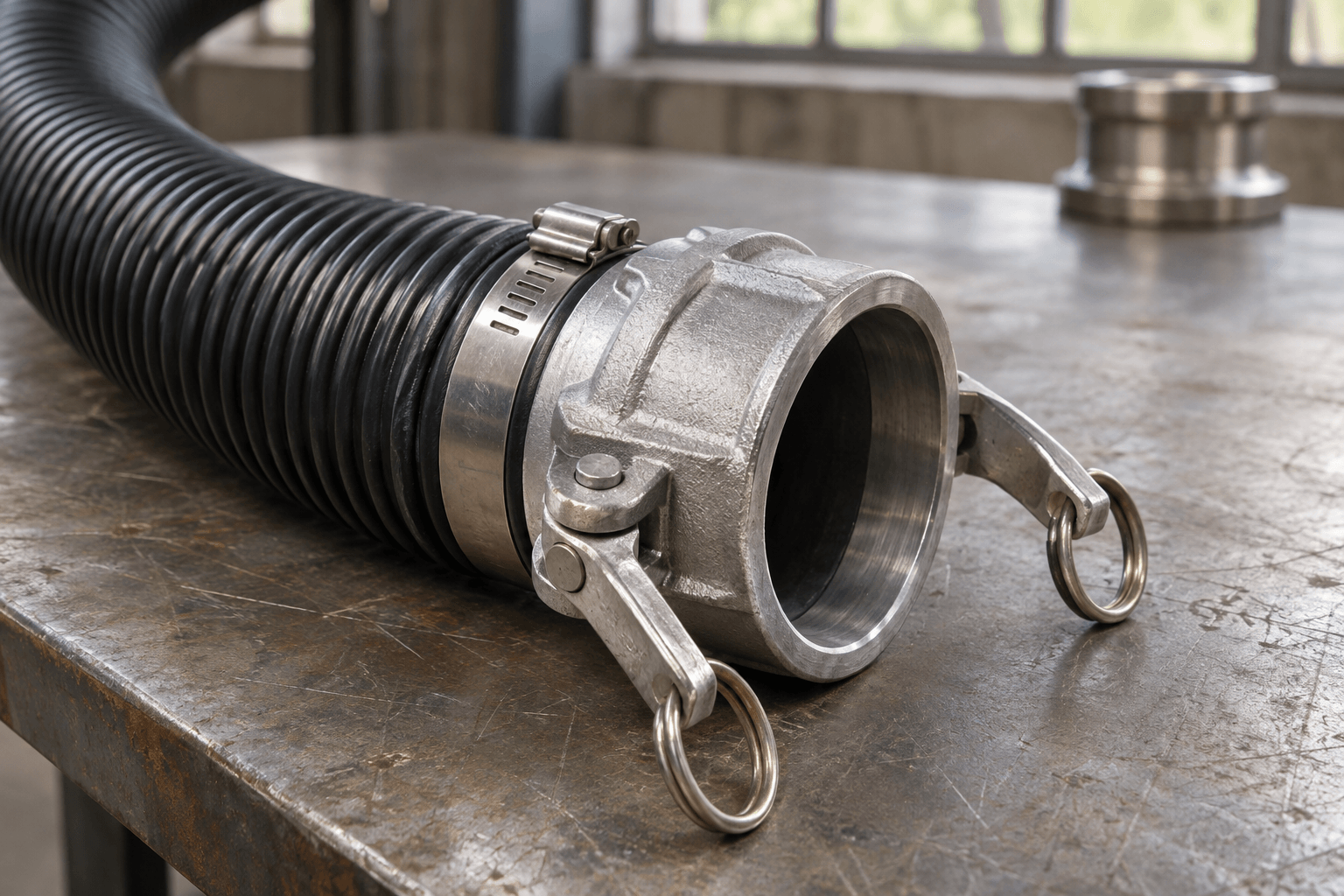
How Charge Builds Up in a Hose
As two surfaces come into contact and separate, charge can move from one to the other. In material handling, powder can repeatedly contact the hose wall as it passes through. Liquid transfer can generate charge as fluid moves through a pipe, valve or filter. The amount that builds up depends in part on the material and how easily charge can move away. A surface or component can keep accumulating charge when it has a poor path to drain it. [2] [4] [9]
That’s why the job description matters more than the name on the hose. Dry powder, a slurry and a flammable liquid present different conditions. A powder that is combustible can present a different hazard when suspended as fine particles in air. The site evaluates the material as handled, including any fines the process produces, and considers the ways it could ignite. An electrostatic discharge is one possible source of ignition. [2] [3] [5]
An operator may notice a shock or see powder clinging to a surface. Those observations can be worth reporting, and the site still needs its own process assessment and measurements. The same electrical path can look perfectly ordinary from the outside. An intact hose cover and a watertight joint give the crew information about the condition of the equipment. The electrical test answers a different question. [1] [2]
Bonding and grounding do different jobs
Bonding connects conductive parts electrically. Given a suitable connection, charge can move between the parts so a large voltage difference is less likely to develop there. Grounding gives the connected system a path to earth. Think about the nozzle, an extension, the hose end and the receiving equipment as individual parts that the site may have to account for. The physical route a material follows and the electrical route a charge can take through the equipment can differ. [2] [9]
The point is easiest to see with a metal fitting. Metal conducts well. If a fitting is isolated from the rest of the equipment, it can still hold charge. A gasket or an insulating section can interrupt a route a person assumed was continuous. At a designated metal contact point, paint or corrosion can also interfere with a connection. The crew needs to know the intended connection points and the site’s method for checking them. [4] [9]
Now put a wire in the hose. If that wire is electrically connected at the ends, it can give charge a route between the two metal fittings. The lining has its own electrical properties. A construction that uses the lining as part of the charge path has to account for how the lining connects to a fitting or another conductive part. Both can be present in the same assembly. Each test still has to match the path the job relies on. [1] [6]
What an incident investigation found
At Barton Solvents’ Des Moines facility, workers were filling a steel tote with a flammable solvent when a fire broke out. The U.S. Chemical Safety Board reported that witnesses said the tote had a grounding clamp. Investigators found electrically isolated metal parts in the fill nozzle and hose setup, including metal parts housed in a plastic nozzle. They determined that a static spark likely ignited vapor at the tote opening. They also found that the nozzle and hose were unsuitable for flammable-liquid transfer. [4]
An easy detail to miss in that account is the stainless steel valve inside the plastic nozzle. The valve conducted electricity, and the plastic around it helped leave it electrically isolated. That’s why a walk-through of the equipment has to include individual conductive parts, even ones inside a component that looks like plastic from the outside. [4]
flexED™ Engineering Insight
A low resistance reading from fitting to fitting can come from the wire alone. When the job calls for an electrical path from the inner lining to a fitting, specify a separate measurement for that path. [1]
What the Standards Cover
The buyer may see a test standard from the hose maker, a fire-protection reference from the site and language from an OSHA rule on the same job. They answer different questions. Match each one to the decision you’re making and keep the applicable documents with the quotation.
ISO 8031 and the finished assembly
ISO 8031:2020 gives electrical test methods for rubber and plastic hose and hose assemblies. It includes testing between metal end fittings and measuring resistance between a conductive or dissipating hose lining or cover and a metal fitting. It also describes tests through the hose wall. Those are separate setups. A number on a certificate is easiest to interpret when it comes with the method and the surfaces or parts that were measured. [1]
| Test location | What the result describes |
|---|---|
| Metal fitting to metal fitting | Electrical continuity or resistance along the connected path between the two ends. |
| Inner lining or cover to a metal fitting | Resistance between the specified hose surface and the fitting it contacts. |
| Through the hose wall | Resistance between the inner and outer surfaces under the specified test setup. |
Use the acceptance criteria the applicable product standard or the site specification gives you. If someone provides a supplier’s number and a site limit, check that both refer to the same test. An end-to-end value in ohms is the resistance measured between the metal fittings on that assembly. A lining-to-fitting value comes from a different path. Ask for the test method if a spec sheet gives you a number without saying what was measured.
Check the units too. A supplier’s assembly guide may express a criterion per foot of hose. A site may ask for a maximum across one finished assembly. Record the length and the units with the reading, and check that the criteria are for the same measurement before comparing the two. It’s the kind of detail that can come up when a replacement is longer than the original, or when a crew wants to use two short sections in place of one long one. [1] [6] [1]
NFPA guidance and U.S. workplace rules
NFPA 77 is a recommended practice for identifying, assessing and controlling static electricity as a fire and explosion hazard. NFPA 660 covers combustible dusts and particulate solids. The latter brings together material previously covered by several separate NFPA dust standards. If a site specification cites an older document, ask which reference and edition the site is using for that operation. [5] [10]
OSHA’s flammable-liquids rule has bonding provisions for specified tank vehicle loading through open domes. A combustible dust cleanup job raises a different set of questions. OSHA’s revised combustible dust inspection directive discusses portable vacuums in the context of the area and equipment, including the hose and conductive attachments. Use those examples to get specific about the job. The site’s safety lead can identify the rules, standards and internal requirements that apply to that operation. [11] [12]
If a customer asks for an “NFPA hose,” get the clause or assembly specification they have in mind. They may be referring to the full vacuum equipment setup the facility has approved. They may need a particular electrical test on one part of that setup. The answer belongs in writing before the fabricator orders components or cuts hose.
Read the Hose Construction Before the Model Name
“Conductive,” “static-dissipating” and “grounding wire” describe different things. The product sheet might be describing the electrical behavior of a tube compound, a piece of metal built into the wall, or the performance of a particular hose assembly. The first move is to find out which of those the manufacturer is describing. If you’re comparing two quotations, put the construction, test points and ratings next to each other. [1] [6]
The tube is the surface the material touches
A manufacturer can formulate a tube compound to allow charge to move through it. Carbon black is one ingredient used for that purpose in some rubber hoses. The electrical property comes from the formulation and the way the hose is built. A black tube or a familiar name for the base polymer gives the buyer too little information to specify an electrical result. Look for the manufacturer’s description and ask for the measurement the job requires. [1] [7] [8]
Pay attention to whether the electrical claim is for the bore or the cover. A hose can have multiple layers with different jobs. The tube is where powder or liquid touches the hose. The cover may see abrasion from the ground and the truck. A specification about one of those surfaces should identify it, especially if the material-contact surface itself has to be part of the path to the rest of the system. [1]
The wire has to be connected where the design calls for it
An embedded copper wire can provide an electrical path through a hose assembly. The fabricator has to make the connection at the intended points using the manufacturer’s instructions for the hose and fittings. If the wire is present but isolated at one end, its presence on the datasheet tells you what’s inside the hose. The assembly test tells you what the two ends are doing electrically. [6] [8]
The reinforcement can be easy to confuse with the grounding wire. A helix can support the hose wall under vacuum or keep the hose from kinking in normal use. Some helixes are rigid plastic. Some hose designs use metal reinforcement. Where a manufacturer intends a metal helix to serve as part of the electrical path, follow the instructions for that exact design and verify it in the assembly. The word “helix” on a spec sheet tells you where to start looking. [6] [7] [8]
A re-hose job is a good place to look for this confusion. An old fitting can come off with a fragment of wire caught at its shank, and a replacement with similar outside markings can use a different construction. Save the original assembly record if there is one. Ask the manufacturer or distributor to verify the current model and its assembly instructions before deciding what to reuse.
Choose for the Conditions the Hose Will See
Once the electrical requirement is clear, work through the mechanical and material requirements. Write the media on the order and describe its condition where it comes into the hose. For example, a dry recovery hose might spend most of its life moving fine material, then take the occasional load with larger pieces that land hard at the first bend. A hose on a liquid recovery truck may pick up a product early in the day and hot wash water later. These details help the distributor verify abrasion resistance, material compatibility and temperature range for the actual work. [13]
Use the operating conditions the truck actually sees
A replacement for vacuum duty needs a vacuum rating for the selected size at the relevant service temperature. Check pressure too if the hose sees positive pressure during any part of the cycle. On a machine with several hose positions, match the spec to the position being replaced. The same diameter may be carried on the truck for more than one job. The distributor needs to know which one the customer is ordering for. [13] [14]
Length is worth asking about even when the customer already knows the diameter. Follow the route from the truck connection to the pickup. A tight turn off a fitting, a long unsupported section or repeated dragging across rough ground can change what the hose has to handle every day. Put the bend and working position in the description. If the fabricator wants to protect an end from repeated flexing, that detail can be worked out with the fittings and hose model in hand. [13] [14]
The fittings deserve their own line on the order. Chemical compatibility still matters at the gasket. The assembly must hold the required vacuum or pressure, and the fittings have to be suitable for the hose and the intended electrical connection. The appearance of the older coupling is helpful for identifying the truck’s mating connection. Use the hose and coupling manufacturers’ guidance to confirm the assembly design. [13] [6]
Treat a change in material as a new question
A truck that’s been approved for one recovery job may be sent to a different one because the crew and equipment are available. An electrical result that passed when the hose was new is useful history. For the new job, have the site review the material and the system that will move it. The original service may have called only for fitting-to-fitting continuity, while the next one might have different requirements for the hose, attachments and vacuum unit. It’s easier to sort that out when the work is planned than when the truck arrives. [2] [12]
What to Keep With the Assembly
The hose shop should be able to identify the assembly long after the ink on a shipment label has rubbed off. Give it an ID and tie the test document to that ID. The work order and record together should show the hose and end fittings, when it was built or serviced, which electrical path was measured, the result and the acceptance criterion. Keep the site specification or its revision with that record so a later repair can be checked against the right document. [6] [13]
Give the fabricator a test it can perform
On the bench, the person taking the reading needs to know what the instruments are measuring. The standard and work instructions establish the contact points and setup. A continuity check between fittings calls for a setup that measures through the assembly itself. For example, a conductive bench can provide a path around the hose if both metal ends touch it. Following the specified setup keeps the test from picking up a connection that disappears as soon as the hose is lifted. [1] [6]
Ask for the measured value in the units the job calls for. A record such as “fitting-to-fitting resistance, tested per the site procedure, meets the specified limit” provides more context than a checkmark next to “static.” Include the number when the job requires it. For an assembly with two required electrical tests, record both results. When the truck operator needs a copy, the shop can send that record with the assembly ID. [1] [6]
Read an unexpected result before changing the hardware
Suppose the shop’s end-to-end reading is within the limit and the site gets a different result after installation. Start by comparing the test points. If the shop measured the two end fittings and the site measured from the pickup tool to the truck, there’s more equipment in the second path. That alone gives the technician a place to start looking. The same reasoning applies if the site tested the lining and the shop tested a wire path. The results need to be interpreted against their own acceptance criteria. [1] [6]
If the two readings cover the same path, have the responsible technician check the method, setup and parts that changed. A different fitting or a loose connection can change what the meter sees. The assembly history helps here. It gives the technician a known build, the date of the last change and a result taken under a specified procedure. Keep that record attached to the original assembly ID so the next test adds to the history. [6] [13]
Keep the installation and the shop record connected
A truck may use several short hose sections joined to reach the work. Each piece can have a shop record. The site still has to establish the required electrical connections across the installed pieces and their attachments. If the crew adds a fitting, adapter or tool, it should know whether that change affects its installation check. The crew should be able to identify the configuration it checked, especially when more than one length or pickup tool can be fitted to the truck. [1] [2] [12]
Have the assembly inspected and checked again under the applicable procedure after a repair or fitting replacement. A re-coupled hose deserves attention because it has a new mechanical connection and may also have a new electrical connection. Crews should follow the site’s inspection and test schedule between repairs. Use signs such as fitting movement, damage at a bend, or wear that exposes internal construction to decide when to pull an assembly in for evaluation under that procedure. [6] [13]
If an assembly fails a required electrical check, document the failing path and keep the hose out of that service until it is evaluated, corrected as appropriate and verified. “Bad hose” gives the shop little to work with. “Resistance from the pickup end to the truck end was outside the site limit after the fitting was changed” points to a defined test and a change the technician can investigate. [1] [6]
How Three Kanaflex Hoses Handle Static Control
Kanaflex’s flexVAC™ line gives a useful example of why the full model number matters. The 180 AR and 180 STAR use abrasion-resistant SBR rubber blended with static-dissipating carbon black. The 180 STAR adds an embedded copper grounding wire. The U Boom ST uses a polyurethane liner and a copper wire, with construction intended for demanding wet and dry abrasive recovery. These are three different construction choices a buyer may see when building a vacuum hose specification. [7] [8] [15]
| Kanaflex hose | Static-control construction |
|---|---|
| flexVAC™ 180 AR (180AR) | Static-dissipating SBR rubber |
| flexVAC™ 180 STAR (ST180AR) | Static-dissipating SBR rubber and a copper grounding wire |
| flexVAC™ U Boom ST (STKB) | Polyurethane liner, static-dissipating construction and a copper grounding wire |
Look at the 4-inch 180 AR and 180 STAR. Both product sheets list a 29.8 inHg vacuum rating and a 4.5-inch minimum bend radius at 72°F. Their listed weights are 1.77 and 1.84 pounds per foot, respectively. That works out to about 89 and 92 pounds for a 50-foot length before fittings. The two models are close enough mechanically that it’s easy to see why the shop in the example needed the electrical specification to finish the quote. [7] [8]
In the counter example, the customer’s order called for a wire connected to the metal ends. That makes the 180 STAR a candidate, subject to the size, ratings and assembly requirements for the job. A buyer looking at an application where the equipment and site specifications allow static-dissipating rubber without a wire can evaluate the 180 AR. For a boom application, the U Boom ST is a separate candidate where its polyurethane-lined construction and dimensions suit the material and the truck. Check the relevant datasheet for the size you’re quoting and confirm the complete assembly before release. [7] [8] [15]
The material choice can bring you to a different product even if the same wire requirement appears in both orders. For a long remote hose, operators may care about the weight they have to move across a job. On a boom, the equipment route and a tight turn near the fitting may drive the choice. Compare the hose’s construction with those details in front of you. Then confirm the electrical path the installed assembly has to provide. [13] [14]
If you’re comparing configurations for industrial vacuum cleanup, flexSELECT™ is a starting point for checking construction, application fit and service ratings. Take the site’s electrical requirements with you when you send a model to the shop for a quote. [14]
Put the Electrical Requirement on the Order
When someone calls for a “static hose,” give the fabricator something more specific to build to. Write the required path and test method next to the diameter, length and fittings. Ask for the result with the assembly. The shop can then answer for the part it built, and the crew has a record to use when it verifies the installation.
The next time that assembly comes in with worn ends and a missing label, its build and test records can tell the story. That’s where a good replacement order pays off.
flexED™ Takeaway
The test report should tell the next person exactly what was measured. List the test points, method and acceptance limit for each electrical path the job relies on, and keep the report with the assembly ID.
Sources & References
[1] ISO 8031:2020, electrical test methods for hose and hose assemblies
[2] OSHA Technical Manual, Combustible Dusts
[3] OSHA, Hazard Communication Guidance for Combustible Dusts
[4] U.S. Chemical Safety Board, Barton Solvents case study
[5] NFPA 77 (2024), Recommended Practice on Static Electricity
[6] Gates, Industrial Hose Safety Connections Guide
[7] Kanaflex, flexVAC™ 180 AR (180AR)
[8] Kanaflex, flexVAC™ 180 STAR (ST180AR)
[9] Canadian Centre for Occupational Health and Safety, Static Electricity
[10] NFPA 660 (2025), Standard for Combustible Dusts and Particulate Solids
[11] OSHA 29 CFR 1910.106(f)(3)(iv), static protection during tank vehicle loading
[12] OSHA, Revised Combustible Dust National Emphasis Program, CPL 03-00-008
[13] NAHAD Hose Safety Institute, Eye on Safety and Reliability for Liquid Vacuum Operations
[14] Kanaflex flexSELECT™, Industrial Vacuum Cleanup
[15] Kanaflex, flexVAC™ U Boom ST (STKB)
About flexED™
flexED™ is Kanaflex’s educational platform for hose applications, performance and selection.