E10, E15 and E85: What Ethanol Blends Mean for Gasoline Hose Compatibility
flexED Knowledge Base
09/01/2026

E10, E15 and E85: What Ethanol Blends Mean for Gasoline Hose Compatibility
“Gasoline” sounds like it should be enough information to select a petroleum hose. It isn’t.
Gasoline sold in the United States can contain different concentrations of ethanol. E10 and E15 are gasoline-ethanol blends. E85, despite its familiar name, is a high-ethanol flex fuel, not gasoline under EPA’s federal definition—and may contain approximately 51% to 83% ethanol.[3][4]
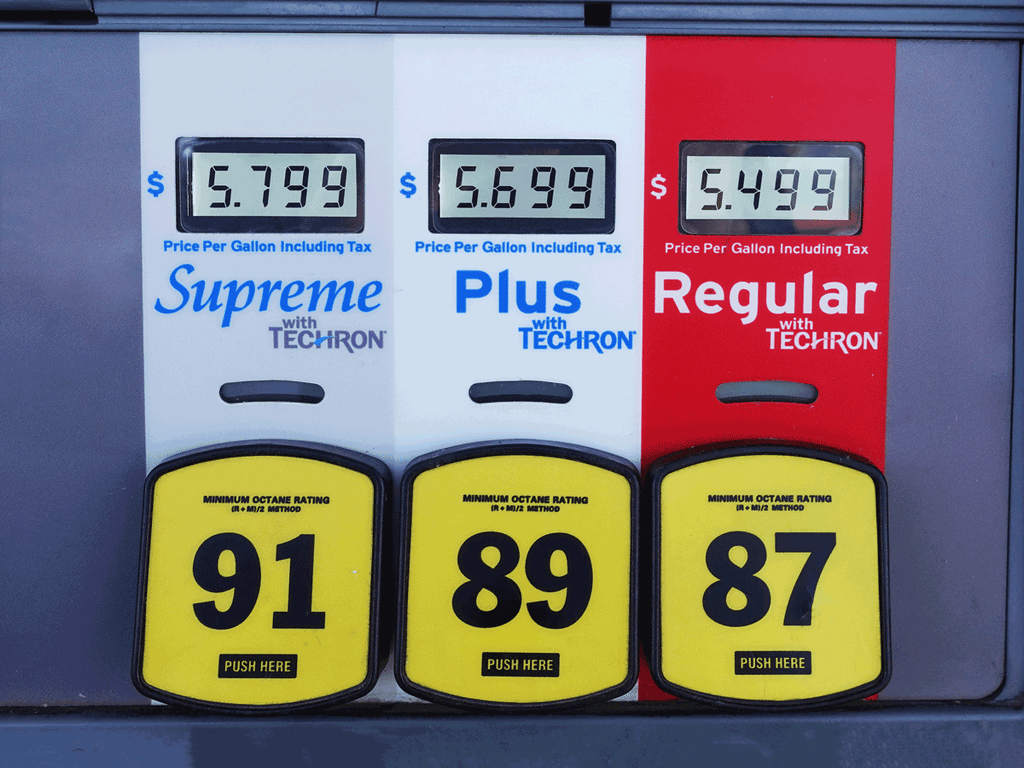
At the same time, the numbers we are accustomed to seeing at the pump like 87, 89, 91 or 93 actually describe something completely different. They describe the fuel’s octane rating.[2]
That distinction has become increasingly important as E15 becomes more common. During 2026, the U.S. Environmental Protection Agency repeatedly issued temporary fuel waivers that allowed broader nationwide distribution and sale of gasoline containing up to 15% ethanol during the summer fuel season.[1]
For anyone specifying petroleum-transfer equipment, however, the important question is this:
When the fuel changes, does the hose that worked for the previous fuel still work for the new one?
The answer depends on the actual fuel blend, the materials used to construct the hose, the operating conditions, and the other components in the transfer system.
Quick Answer: Is a Gasoline Hose Automatically Compatible With E15 or E85?
No.
A hose being suitable for gasoline does not automatically establish that it is suitable for every gasoline-ethanol blend.
The first question should be:
What fuel will actually be transferred?
Then:
What ethanol concentration must the hose be able to handle?
That difference matters because ethanol changes the chemical environment that contacts the hose tube, seals, gaskets and other wetted components. Different materials, and even different formulations of the same general type of material can respond differently when exposed to ethanol-blended gasoline.[6][8]
EPA uses essentially the same principle when regulating federally covered underground storage tank systems. Its rules require the system to remain compatible with the substance being stored and impose additional compatibility requirements when the fuel contains more than 10% ethanol.[6][7]
That does not mean every industrial petroleum hose is regulated as an underground storage tank component. It means the underlying engineering principle is important enough that federal fuel-storage regulations explicitly recognize that changing the fuel can change the compatibility requirement.
flexED™ Engineering Insight
“Gasoline compatible” describes a starting point. The actual gasoline-ethanol blend determines the chemical compatibility requirement.
What Do 87, 89, 91, 93, E10, E15 and E85 Actually Mean?
Before discussing hose compatibility, it helps to clear up one of the most confusing parts of modern gasoline. There are two completely different numbering systems at the pump.
87, 89, 91 and 93 Describe Octane
In the United States, gasoline is generally sold as:
| Fuel Grade | Typical Octane Rating |
|---|---|
| Regular | 87 |
| Midgrade | 89–90 |
| Premium | 91–94 |
The octane rating describes the gasoline’s resistance to engine knock. Higher-octane gasoline is required or recommended by some engines because of the way those engines are designed.[2]
So premium gasoline simply means higher-octane gasoline. It does not mean “more petroleum.” It does not mean “less ethanol.” And it does not mean E85.
E10, E15 and E85 Describe the Ethanol Blend
The E stands for ethanol. The number refers to the ethanol portion of the fuel, although E85 has an important complication.
| Fuel | What It Means | Approximate Gasoline/Hydrocarbon Portion |
|---|---|---|
| E10 | About 10% ethanol | ~90% |
| E15 | 15% ethanol | ~85% |
| E85 | 51%–83% ethanol | ~17%–49% |
E10 is now common throughout the United States. E15 contains 15% ethanol. E85, ethanol flex fuel, is formulated under ASTM D5798 and can contain 51% to 83% ethanol depending on geography, season and fuel-property requirements.[3][4]
So an E85 dispenser does not necessarily contain exactly 85% ethanol. That is an important distinction for equipment selection.
Octane and Ethanol Are Not the Same Measurement
A fuel can have both an octane designation and an ethanol designation because they describe different characteristics.
Think of it this way:
87 / 89 / 91 / 93 → How the fuel behaves during combustion
E10 / E15 / E85 → How much ethanol is in the fuel blend
For hose selection, the second designation is generally far more important because it tells us something about the chemical mixture actually contacting the hose.
What Is the Rest of E10, E15 or E85 Made Of?
If E15 is 15% ethanol, what is the other 85%? Primarily gasoline. But even the word gasoline is a simplification.
The U.S. Energy Information Administration defines finished motor gasoline as a complex mixture of volatile hydrocarbons, sometimes containing small quantities of additives. Refiners and blending facilities adjust gasoline composition to meet requirements for octane, volatility, emissions and seasonal or regional fuel specifications.[5]
That means gasoline itself is not one chemical. It is already a mixture. Adding ethanol changes that mixture again.
With E10, ethanol represents approximately one-tenth of the finished fuel. With E15, it represents approximately 15%. With E85, ethanol can become the majority of the liquid.
For hose engineers, that matters because the hose is not simply being exposed to “gasoline plus a little extra ethanol.” At high ethanol concentrations, the relative chemical environment inside the hose can be substantially different.
Why Ethanol Changes the Hose-Compatibility Question
A hose tube is a polymeric material created to provide a particular combination of flexibility, strength, chemical resistance, temperature performance and service life.
When that material contacts fuel, some of the fuel’s components can interact with the polymer.
Depending on the material and formula, those interactions can change physical properties such as:
- Volume
- Hardness
- Flexibility
- Mass
- Dimensional stability
- Permeation behavior
EPA warns that incompatible fuel-system materials may become brittle, elongated, thinner or swollen and may temporarily or permanently lose properties such as their original shape or flexibility.[6]
Oak Ridge National Laboratory studied this issue extensively using elastomers, metals, plastics and sealants found in fueling infrastructure. Researchers measured properties including volume change, mass change, hardness, tensile behavior and other mechanical characteristics after exposure to ethanol-containing test fuels.[8][9]
The important finding for hose users is not that one material is universally “good” and another universally “bad.”
It is that material compatibility depends on both the material formulation and the fuel formulation.
More Ethanol Does Not Automatically Mean More Damage
This is where the subject becomes more interesting.
It would be easy to assume:
E10 < E15 < E85
therefore:
E85 must always be progressively harder on every material.
The research does not support that as a universal rule.
Fuel compatibility is not necessarily a straight line where every additional percentage point of ethanol produces proportionally more damage.
ORNL found that some elastomers experienced significant swelling or property changes when ethanol was first introduced into gasoline, but the additional change when moving from E10 to E15 could be relatively small for the materials tested.[9]
For example, ORNL’s E15 analysis reported that nitrile rubber and several other elastomer types showed changes when exposed to ethanol-containing fuels, but the additional swelling and softening associated with moving specifically from E10 to E15 was generally limited in the materials evaluated.[9]
At much higher ethanol concentrations, however, certain legacy materials and resin systems behaved very differently. ORNL testing with fuels representing E50 and E85 found severe degradation in one particular legacy fiberglass-tank resin system while other tested systems behaved differently.[9]
That is why a generic material statement such as:
“Nitrile works with gasoline.”
or
“Polyurethane handles ethanol.”
isn’t specific enough to select a hose.
The exact compound, hose construction, fuel blend and operating conditions matter.
flexED™ Engineering Insight
Do not select an ethanol-fuel hose from a generic material chart alone. A polymer family is not the same thing as a finished hose formulation with a manufacturer-defined compatibility range.
That distinction is especially important because ORNL itself cautions that elastomers within the same general material class can have different formulations and additives. Its research was designed to identify material-property changes but not to create universal pass/fail ratings for every commercial product.[8]
Why Does EPA Care About the 10% Ethanol Threshold?
Federal underground-storage regulations provide a useful example of how seriously fuel compatibility is treated.
Under 40 CFR §280.32, owners and operators of federally regulated underground storage tank systems must use systems compatible with the substances they contain.[7]
When switching to a regulated substance containing greater than 10% ethanol, additional requirements apply. Among other things, the owner/operator must notify the implementing agency and demonstrate compatibility using acceptable documentation or another approved method.[6][7]
EPA specifically identifies the distinction:
E10: The additional greater-than-10%-ethanol compatibility demonstration is not triggered.
E15: It is.
E85: It is.
EPA also says manufacturer documentation used to establish compatibility should affirm compatibility and specify the range of biofuel blends with which the component is compatible.[6]
That last point is remarkably relevant to hose selection.
It isn’t enough to say:
“This component handles ethanol.”
The meaningful question is:
“What range of ethanol blends does it handle?”
Important Distinction
These UST regulations apply to federally regulated underground storage systems. They should not be presented as a blanket federal regulation covering every tank-truck drop hose, industrial transfer hose or petroleum hose application.
But the regulations demonstrate the same engineering principle that applies when choosing a hose:
Know the actual fluid composition and verify compatibility with that composition.
E15 Is Becoming More Relevant
The compatibility issue is especially timely because E15 is becoming more visible in the U.S. fuel market.
EPA identifies E15 as gasoline containing 15% ethanol. During the 2026 summer fuel season, EPA repeatedly issued temporary emergency waivers allowing a national gasoline pool containing between 9% and 15% ethanol under specified volatility conditions.[1]
The agency’s August 20, 2026 action continued those temporary fuel measures into the end of the summer control period.[1]
Separate EPA actions have also expanded year-round E15 treatment in several Midwestern states.[1]
This does not mean E85 is a new fuel or that a new 2026 regulation suddenly created E85. E85 has existed for years. The current development is that higher-than-E10 gasoline, particularly E15, is becoming increasingly relevant to fuel distribution and storage decisions.
For a petroleum hose manufacturer, distributor or user, that creates a very practical reason to stop treating the word “gasoline” as a complete chemical specification.
A Fuel-Transfer System Is More Than the Hose Tube
The hose tube receives the most attention because it is the primary surface contacting the fuel. But it isn’t necessarily the only material exposed to the product.
A fuel-transfer or dispensing system may also include couplings, seals, O-rings, gaskets, valves, swivels, breakaways and other components.
ORNL’s work demonstrates why this matters. Its fueling-infrastructure studies evaluated not only elastomers but also metals, sealants, piping materials, couplings and fittings because compatibility problems can occur at component interfaces as well as in the primary fluid path.[8][9]
UL’s standards structure makes the same concept visible from another direction.
For gasoline dispensing equipment, UL maintains separate standards covering equipment intended for different ethanol concentrations. UL 330A addresses hose and hose assemblies used with dispensing devices for gasoline and gasoline/ethanol blends with nominal ethanol concentrations up to E85. Separate standards address breakaway fittings, swivel connectors, valves, nozzles and other dispensing components.[10]
Again, those UL dispensing standards should not be confused with specifications for every industrial or tank-truck petroleum hose.
But they illustrate an important systems principle:
Every component exposed to the fuel has to be appropriate for the fuel it actually sees.
An E85-compatible hose connected to an incompatible seal does not create an E85-compatible transfer system.
What Does Fuel Incompatibility Look Like?
Chemical incompatibility does not necessarily begin with a dramatic hose rupture. Material changes can develop gradually.
Depending on the material and fuel, warning signs may include changes in flexibility, swelling, softening, hardening, cracking, dimensional change or deterioration around seals and connections.[6][8][9]
ORNL testing also demonstrated an important phenomenon after fuel exposure: some elastomers changed again during dry-out. Certain nitrile and neoprene specimens experienced shrinkage and embrittlement associated with the extraction of plasticizer components after exposure.[9]
That means inspection can be more complicated than looking for one obvious visual symptom while the hose is in service.
A hose can still appear functional while its material properties are changing.
flexED™ Engineering Insight
Compatibility is not the absence of immediate failure. It is the ability of the hose and its components to maintain the properties required for the intended service.
How Do I Select a Petroleum Hose for E10, E15 or E85?
Instead of beginning with a hose model, begin with the application.
1. What Fuel Is Actually Being Transferred?
“Gasoline” may not be specific enough. Determine whether the application involves E10, E15, E85 or another fuel altogether. For high-ethanol flex fuels, establish the actual specification being used rather than assuming the number in the common fuel name is the precise composition.
2. What Is the Maximum Ethanol Concentration the Hose Must Handle?
If the equipment could encounter different blends, evaluate it against the most demanding blend that may actually enter the system.
E85 is especially important here because ASTM D5798 flex fuel can range from 51% to 83% ethanol.[4]
3. What Does the Hose Manufacturer Actually Approve?
Look for an explicit compatibility statement.
There is a meaningful difference between:
“For gasoline”
“For ethanol blends”
and
“For E85.”
If the manufacturer does not specify the concentration required by the application, do not fill in the missing information yourself.
Ask.
4. What Pressure and Temperature Must the Hose Handle?
Chemical compatibility is only one part of hose selection. A chemically compatible hose can still be wrong if its working pressure, vacuum rating, temperature range, bend radius or construction does not meet the application.
5. Are the Rest of the Wetted Components Compatible?
The fuel may also contact:
Couplings → Gaskets → Seals → O-rings → Valves → Swivels → Other transfer equipment
Those components need to be evaluated for the same fuel.
6. What Static-Control Construction Does the Application Require?
Petroleum-transfer applications also require attention to static electricity and the overall grounding and bonding system.
Specific Kanaflex flexFUEL™ hoses, for example, incorporate static-dissipating tubes and static grounding wires as part of their construction.[11][12][13]
That does not remove the need to properly design, assemble and ground the complete transfer system.
Selecting the Right Gasoline Hose Is Only the Beginning
Selecting a gasoline hose that is compatible with the fuel is the first step.
The next question is:
Will that hose remain fit for service throughout its working life?
A gasoline hose does not operate in a laboratory. Once it enters service, the assembly may be exposed to repeated flexing, pressure cycles, dragging, abrasion, weather, temperature changes, coupling loads and general handling damage.
At the same time, chemical exposure can gradually change the properties of some hose materials without producing an immediate or obvious failure. That means hose safety should not depend entirely on waiting for an operator to notice a leak, crack or other visible problem. A more proactive approach is to manage the hose assembly throughout its service life.
NAHAD’s Hose Safety Institute treats specification, design, fabrication, handling, testing and management as interconnected parts of hose-assembly safety. Its current best practices also call for documented testing procedures, hose identification and tagging, properly maintained test equipment and accurate records.[14]
What Is a Hose-Management Program?
A hose-management program creates a documented history for individual hose assemblies instead of treating every hose as an anonymous piece of equipment.
Depending on the application and the program being used, that record may include:
- Unique hose or assembly identification number
- Hose manufacturer and product
- Date the assembly entered service
- Intended fuel
- Approved ethanol concentration or fuel range
- Working pressure and temperature requirements
- Hose and coupling information
- Inspection history
- Test history
- Repairs, abnormalities or damage observed
- Changes in application
- Removal-from-service criteria
- Next scheduled inspection or test
For gasoline service, one of the most valuable pieces of information may simply be:
What fuel was this hose originally selected to transfer?
Consider a facility with dozens of gasoline hose assemblies.
Some may have been selected years ago for E10.
Some may have documentation stating only “gasoline and ethanol blends.”
Others may have documented approval for E85.
If that facility begins handling E15 or E85, the hose records provide a way to identify which assemblies need to be reviewed before the new fuel is introduced.
Without those records, the operator may be forced to determine the history and compatibility of each hose after the fact.
flexED™ Engineering Insight
A change in fuel should trigger a review of the hose record—not an assumption that the existing hose can remain in service.

Inspection and Testing Answer Different Questions
A hose-management program also makes proactive inspection possible.
NAHAD specifically trains distributors to develop end-user inspection programs designed to help customers determine whether industrial hose assemblies remain safe, functional and appropriate for their applications.[15]
A visual inspection may identify conditions such as:
- Cuts or gouges
- Excessive abrasion
- Cracking
- Kinking or flattening
- Soft spots or blistering
- Hardening or loss of flexibility
- Exposed reinforcement
- Leakage
- Corroded or damaged fittings
- Movement of the hose at the coupling
- Other signs of physical deterioration
But visual inspection has limitations. A hose can look acceptable externally while changes are occurring within the tube, reinforcement, coupling interface or conductive components.
For that reason, an appropriate hose-management program may also include periodic testing of the completed assembly.
The exact testing required depends on the hose, its construction, the application, manufacturer recommendations and any applicable industry or regulatory requirements.
Pressure or Leak Testing
For assemblies where pressure testing is appropriate, a qualified hose fabricator or service provider can test whether the assembly maintains the specified test condition without leakage, coupling movement or other evidence of failure.
Industry technical guidance commonly combines pressure testing with visual inspection of the hose and fittings. Gates, for example, recommends inspection for cuts, abrasion, bulges, soft spots, coupling slippage and leakage as part of its industrial hose testing guidance.[16]
The important point, however, is what a pressure test does not tell you. Passing a pressure test does not prove that a hose is chemically compatible with E15 or E85.
A hose could hold pressure during a test and still be constructed from materials that are not approved for long-term exposure to the fuel being transferred. Chemical compatibility and mechanical integrity are separate questions.
Electrical-Continuity Testing
Static control introduces another reason proactive testing can matter in gasoline-transfer service.
Some fuel-transfer hose assemblies use conductive materials, static wires or other construction designed to provide an electrical path through the assembly.
Where electrical continuity is part of the hose design or application requirement, that path can be tested using the procedure and acceptance criteria appropriate to the assembly.
Gates’ industrial hose safety guidance, for example, includes electrical-continuity inspection using an ohmmeter and recommends recording the results with the hose’s maintenance records.[16]
Again, the test answers a specific question:
Does the intended conductive path through this particular assembly remain intact?
It does not establish chemical compatibility, pressure capability or overall application suitability by itself.
flexED™ Engineering Insight
Testing cannot make an incompatible hose compatible. Testing helps determine whether a correctly selected hose assembly remains fit for service.
Why the Distributor Can Play an Important Role
This is where the role of a qualified hose distributor extends beyond simply supplying a replacement hose.
A distributor with a hose-management or inspection program can help an end user:
Identify → Document → Inspect → Test → Track → Replace
hose assemblies throughout their service life.
NAHAD’s Hose Safety Institute specifically promotes distributor best practices around hose selection, fabrication, testing, identification, record keeping and management.[14] NAHAD also provides training designed to help member distributors establish inspection programs at end-user facilities.[15]
For an operation handling ethanol-blended gasoline, that creates an important opportunity for proactive management.
When the fuel changes, the distributor can help address two different questions:
1. Is the hose assembly actually specified for the new fuel blend?
and
2. Is this particular hose assembly still mechanically fit for continued service?
Those are not the same question.
A hose could be chemically appropriate for E85 but physically damaged after years of service.
Another hose could be mechanically sound but lack documented compatibility with E85.
A strong hose-management program is designed to identify both situations before they become failures in the field.
There Is No Universal Test Interval
One point is especially important. There is no single inspection or testing interval that should automatically be applied to every gasoline hose.
How frequently a hose should be inspected or tested can depend on factors such as:
- Hose construction
- Severity of service
- Frequency of use
- Fuel being transferred
- Pressure and temperature
- Handling conditions
- Previous service history
- Manufacturer recommendations
- Distributor or end-user safety procedures
- Applicable industry standards or regulations
A hose that operates continuously in severe service may justify a very different inspection program from one used occasionally under controlled conditions.
The goal is not to create an arbitrary calendar interval. The goal is to establish a documented inspection and testing program appropriate to the risk and the application.
Worked Example: An Existing E10 Operation Begins Handling E85
Consider a distributor that has used the same petroleum hose for years to unload E10 gasoline.
A new customer now requires E85.
The operator asks:
“It is already a gasoline hose. Can we just keep using it?”
Let’s work through the selection process.
What Changed?
The previous fuel contained approximately 10% ethanol. The new fuel may contain anywhere from 51% to 83% ethanol.[4] That is not a minor change in the product-contact environment.
What Does the Existing Hose Documentation Say?
Suppose the hose data only states:
“For gasoline and ethanol blends.”
Does that prove it is suitable for E85?
No.
But it also does not prove the hose is incompatible with E85.
The correct answer is:
UNCONFIRMED
There is not enough information in that statement alone to establish the maximum approved ethanol concentration. That is an important distinction. Engineering does not require us to declare the hose unsafe without evidence. It requires us not to assume compatibility without evidence.
The next step is to obtain an explicit compatibility statement from the hose manufacturer for the required fuel blend.
Now consider a second hose whose manufacturer explicitly states compatibility with gasoline and ethanol concentrations from E85 through E100.
For an E85 application, the chemical-compatibility question now has a documented answer.
CHEMICAL COMPATIBILITY CHECK: PASS
But the hose still isn’t automatically the correct hose. Pressure, temperature, size, flow requirements, static-control construction, couplings and the rest of the assembly still have to satisfy the application.
That is the same distinction we have made throughout flexED:
One qualification gets a hose into consideration. It does not complete the selection process.

Now Consider the Entire Hose Fleet
Suppose the distributor then reviews the customer’s hose inventory and discovers that the facility has 18 gasoline hose assemblies currently in service.
- Twelve were originally documented for the E10 application.
- Four have incomplete fuel-compatibility records.
- Two have documentation explicitly establishing compatibility with E85.
The transition from E10 to E85 is no longer simply a question about one hose.
It becomes a hose-management issue.
The distributor can identify the assemblies whose compatibility needs to be confirmed, review the condition and history of the remaining hoses, perform applicable inspection and testing, document the results and establish the next inspection point.
The twelve hoses originally selected for E10 are not automatically condemned simply because the fuel is changing.
But they are also not automatically approved for E85.
Their documented compatibility has to be established.
Likewise, the two hoses already documented for E85 should not automatically remain in service forever simply because their materials are chemically compatible.
Their physical condition still matters.
This creates two separate decisions:
| Question | What Determines the Answer? |
|---|---|
| Can this hose handle E85? | Fuel and material compatibility |
| Should this particular hose remain in service? | Inspection, testing, condition and service history |
That distinction is the reason proactive hose management is so valuable.
Instead of replacing hoses only after a visible problem develops, the operator and distributor can manage the entire hose fleet as a group of documented assets.
flexED™ Engineering Insight
The goal of hose management is not to predict the exact day a hose will fail. It is to identify changing conditions, questionable assemblies and developing problems before failure becomes the first warning.
Different Petroleum Hoses Can Have Very Different Compatibility Statements
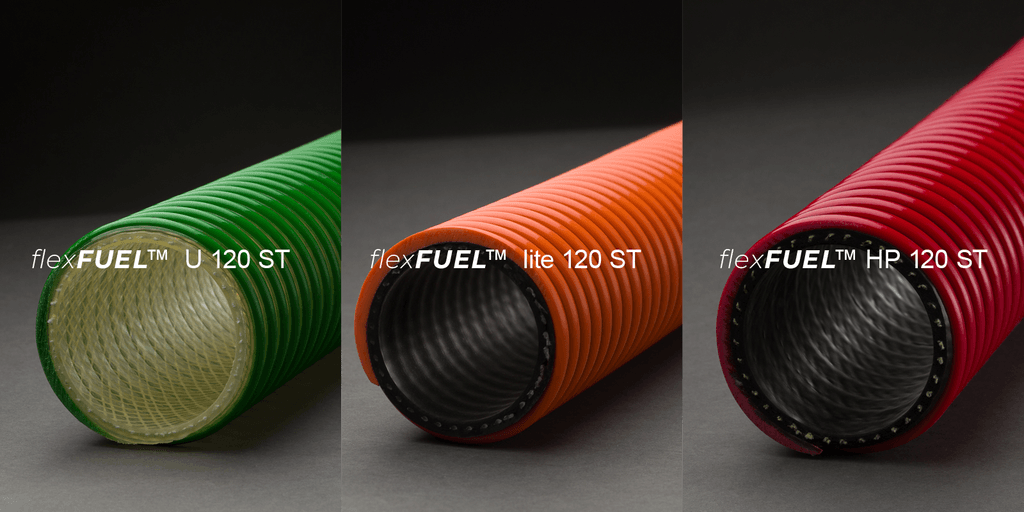
Kanaflex’s own flexFUEL™ line provides a useful real-world example.
These products all belong to the petroleum and fuel-transfer category, yet their published specifications are not identical.
| Hose | Tube Construction | Published Ethanol Language | Working Pressure at 72°F |
|---|---|---|---|
| flexFUEL™ U 120 ST | Static-dissipating polyurethane | Explicitly states ethanol E85 to E100, plus gasoline and other fuels | 65 psi |
| flexFUEL™ HP 120 ST | Static-dissipating nitrile rubber | States gasoline and ethanol blends | 150 psi |
| flexFUEL™ lite 120 ST | Static-dissipating nitrile rubber | States gasoline and ethanol blends | 65 psi |
Kanaflex specifically describes flexFUEL™ U 120 ST as providing resistance to gasoline, biodiesel, ethanol E85 to E100, kerosene, diesel and ASTM fuel oils.[11]
The published pages for flexFUEL™ HP 120 ST and flexFUEL™ lite 120 ST describe them for gasoline and ethanol blends but do not currently state a specific maximum ethanol percentage on the web page.[12][13]
That does not mean those hoses are unsuitable for E85.
It means the web language alone does not establish an E85 rating.
That difference perfectly illustrates the point of this article:
“Petroleum hose” is a product category. It is not a complete chemical-compatibility specification.
The user still has to match the actual hose to the actual fuel.
The Fuel Blend Is Part of the Hose Specification
The petroleum market is changing, but the engineering principle is not new. A hose should always be selected for the material actually moving through it. What has changed is that the word gasoline increasingly hides an important variable. E10 and E15 are both gasoline. E85 is also a gasoline-ethanol fuel.
But they do not expose transfer equipment to exactly the same chemical environment. And higher ethanol content does not create one simple, predictable progression of material damage. Research shows that different materials and formulations can respond differently at different blend levels.[8][9]
That is why the best question is not:
“Can this hose handle gasoline?”
It is:
“Which gasoline-ethanol blends is this hose designed and approved to handle under my operating conditions?”
Identify the fuel and then identify the ethanol concentration. Next, verify the hose compatibility. Then evaluate pressure, temperature, static control and every other component in the transfer system.
flexED™ Engineering Insight
“Gasoline” gets you into the right hose category. The actual fuel blend helps determine whether you have selected the right hose.
Sources & References
[1] U.S. Environmental Protection Agency — Fuel Waivers / 2026 E15 Actions
[2] U.S. Energy Information Administration — Gasoline Explained: Octane in Depth
[3] U.S. Energy Information Administration — How Much Ethanol Is in Gasoline?
[6] U.S. Environmental Protection Agency — Emerging Fuels and Underground Storage Tanks
[7] Electronic Code of Federal Regulations — 40 CFR §280.32: Compatibility
[10] UL Solutions — Fuel Dispensing Equipment Testing, Inspection and Certification
[11] Kanaflex Corporation — flexFUEL™ U 120 ST (ST120 UAPDH)
[12] Kanaflex Corporation — flexFUEL™ HP 120 ST (ST120HP)
[13] Kanaflex Corporation — flexFUEL™ lite 120 ST (ST120LT)
[14] NAHAD — Hose Safety Institute Designation and Best Practices
[15] NAHAD — Industrial Hose Inspections (End User Sites)
[16] Gates Corporation — Industrial Hose Safety Connections Guide
About flexED™
flexED™ is Kanaflex’s educational platform focused on hose applications, best practices, and technical knowledge. Our goal is simple: help users make better hose decisions, improve reliability, and get more from every hose in service.