Hose Collapse: Why it Happens and How to Prevent It
flexED Knowledge Base
07/09/2026

Why Hoses Collapse and How to Prevent it.
Manufacturers design every vacuum hose to resist the crushing force of atmospheric pressure. Yet, despite using hoses specifically rated for vacuum service, operators still experience collapsed hoses, reduced productivity, costly downtime, and, in some cases, serious safety hazards.
When a hose suddenly flattens during operation, the first assumption is often that “the vacuum was too strong.” In reality, that’s rarely the whole story.
A combination of factors like excessive bending, elevated temperatures, physical damage, aging, improper hose selection, and mechanical abuse cause hose collapse. By the time a hose visibly collapses, the conditions leading to failure have often been developing long before the job began. Parker’s Industrial Hose Safety Guide emphasizes that hose performance depends on proper application, routing, environmental conditions, inspection, and maintenance.¹
The good news is that hose collapse is often predictable.
Unlike sudden failures caused by accidental damage or unexpected pressure spikes, collapse typically leaves warning signs. Understanding how vacuum works, how hose construction resists collapse, and what operating conditions accelerate failure allows operators to identify potential problems before they result in downtime.
This article explores the engineering principles behind vacuum hose collapse, explains why some hoses survive demanding applications while others fail prematurely, and provides practical guidance for selecting, inspecting, and operating vacuum hoses with greater confidence.
Whether you’re working in hydro excavation, industrial vacuuming, material transfer, or pneumatic conveying, understanding the forces acting on a vacuum hose is one of the most effective ways to improve reliability, extend service life, and reduce unexpected failures.
What Actually Causes Collapse?
When people think about vacuum systems, they often imagine the vacuum “pulling” a hose inward until it collapses. While that seems logical, it’s not actually what happens.
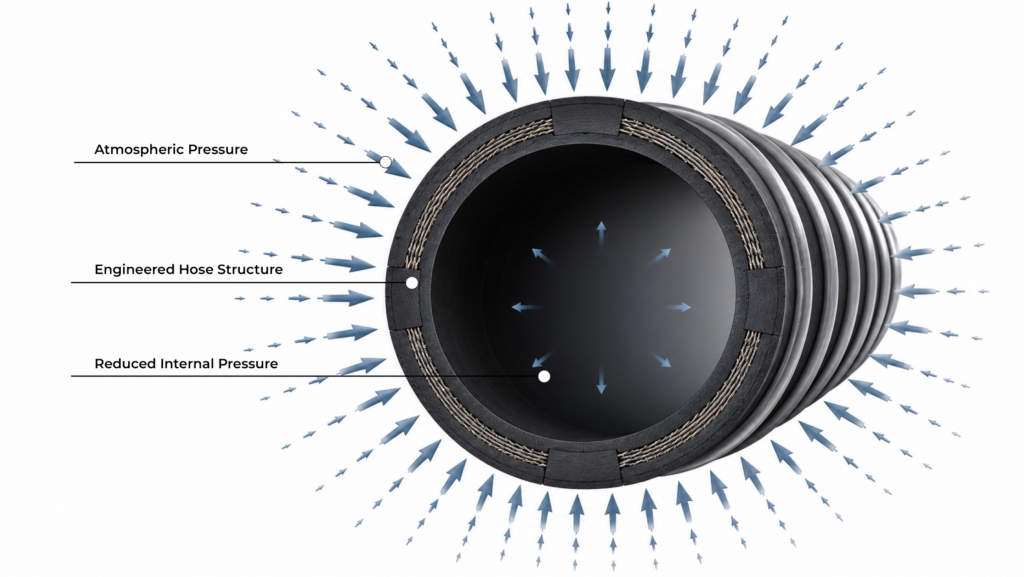
Vacuum is simply pressure below atmospheric pressure. A vacuum pump removes air from inside the hose, reducing the internal pressure. The atmosphere surrounding the hose, however, remains at approximately 14.7 psi (101.3 kPa) at sea level. The greater the difference between the pressure inside the hose and the surrounding atmospheric pressure, the greater the compressive force acting on the hose wall.²
In other words:
The vacuum isn’t pulling the hose inward. Atmospheric pressure is pushing it inward.
This distinction is more than just an engineering technicality. It explains why hose construction is so important. Engineers design vac hoses to resist this constant external load. Reinforcement layers, rigid PVC helices, steel wire, wall thickness, and material stiffness all work together to prevent the hose from deforming under atmospheric pressure. As long as those structural elements maintain their integrity, the hose remains round and continues to perform as designed.¹ ³
Excessive heat can soften hose materials. Sharp bends can reduce the hose’s ability to support itself. Abrasion gradually removes protective material. Mechanical abuse can permanently deform reinforcement components. Even natural aging slowly changes material properties.
Individually, these factors may have only a modest effect. Together, they reduce the hose’s ability to resist atmospheric pressure.
Eventually, the external force exceeds the hose’s remaining structural strength. That’s when collapse occurs. Understanding this principle will change the way you evaluate vacuum hose failures.
Instead of asking:
“How much vacuum caused the collapse?”
the better question becomes:
“What reduced the hose’s ability to resist atmospheric pressure?”
The answer is rarely a single cause. More often, it is the cumulative effect of application conditions, installation practices, environmental exposure, and normal wear.
flexED™ Engineering Insight
Think of a vacuum hose as a structural component—not simply a flexible tube. Its job isn’t just to transport material. Its job is to continuously resist thousands of pounds of external atmospheric force while remaining flexible enough to move with the application. The better you protect that structure, the longer the hose will perform.
Why One Hose Collapses and Another Doesn’t
If two vacuum hoses are connected to identical vacuum systems, operating at the same vacuum level, why might one continue performing normally while the other collapses?
The answer lies in the hose’s collapse resistance, or its ability to maintain its shape while resisting the constant external force of atmospheric pressure.
Collapse resistance isn’t determined by a single feature. It results from a combination of engineering decisions that influence how the hose behaves under load. These include material selection, reinforcement design, wall thickness, hose diameter, operating temperature, bend radius, and the overall condition of the hose. Even when two hoses appear similar externally, differences in construction can produce dramatically different performance in demanding vacuum applications.¹
Hose Construction
The first line of defense against collapse is the hose’s construction.
Vacuum-rated hoses rely on reinforcement systems that prevent the hose wall from deforming under atmospheric pressure. Depending on the application, this reinforcement may include rigid PVC helices, embedded steel wire, textile reinforcement, or combinations of multiple reinforcement layers.
Each design represents a balance between flexibility, weight, vacuum performance, abrasion resistance, and handling characteristics.
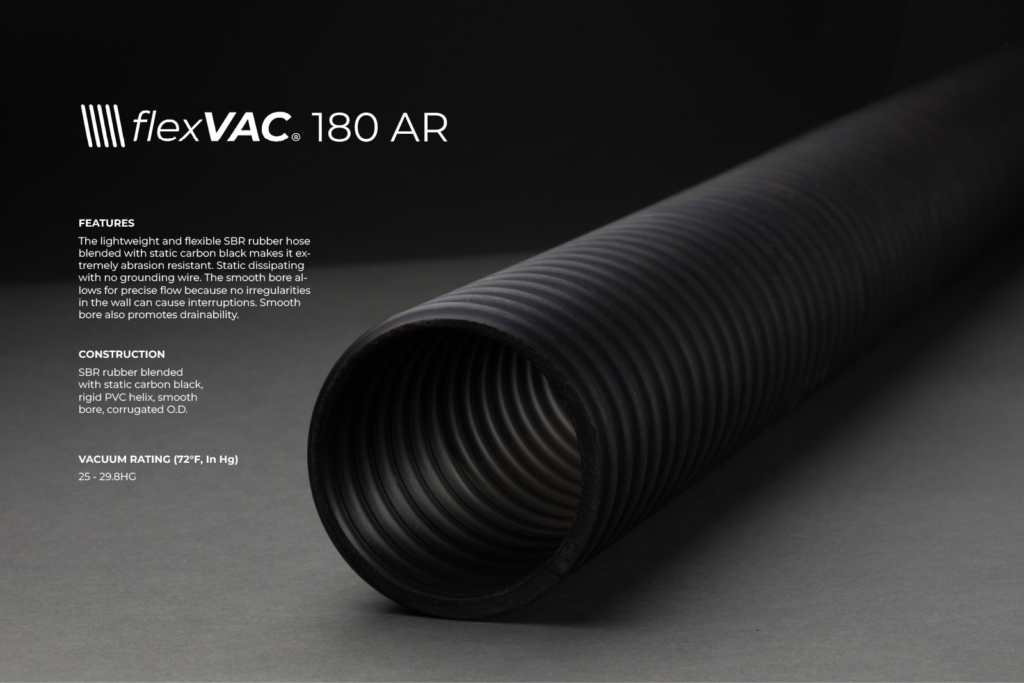
For example, Kanaflex’s flexVAC™ 180 AR is engineered specifically for demanding abrasive vacuum applications. Its rigid external PVC helix provides excellent collapse resistance while maintaining the flexibility required for vacuum truck service, industrial cleanup, and abrasive material transfer.
Applications involving elevated temperatures require a different engineering approach. The flexVAC™ 180 HR combines excellent vacuum performance with an EPDM construction capable of operating at temperatures up to 220°F, allowing it to maintain performance in environments where conventional hose materials may soften prematurely.⁴
Neither hose is universally “better.” Each is engineered to solve a different application challenge.
Selecting the correct hose begins with understanding the operating environment.
Diameter Matters More Than Many People Realize
As hose diameter increases, so does the amount of surface area exposed to atmospheric pressure. That means larger hoses experience greater compressive loads and require more structural support to maintain their shape under vacuum. This is one reason manufacturers publish vacuum ratings for each hose diameter rather than assigning a single rating to an entire product family.³ Choosing a hose based solely on flow requirements without considering published vacuum ratings can significantly reduce safety margins.
A Hose’s Condition Matters Just as Much as Its Design
Even the best-engineered hose cannot perform indefinitely if its structural integrity has been compromised.
Repeated over-bending, crushing, abrasion, excessive heat, UV exposure, ozone, and mechanical abuse gradually reduce a hose’s ability to resist atmospheric pressure. The hose may continue operating normally until the day it experiences maximum vacuum demand. Then, seemingly without warning, it collapses. This is why routine inspection is every bit as important as proper hose selection.
The question isn’t simply:
“Is this the right hose?”
It’s also:
“Is this hose still capable of doing the job it was designed to do?”
Understanding the relationship between construction, diameter, and condition transforms hose collapse from an unpredictable event into something that can be evaluated, monitored, and often prevented.
The Six Failure Multipliers That Accelerate Collapse
Vacuum hose collapse is rarely caused by a single mistake. Instead, it is usually the result of several operating conditions working together to reduce the hose’s ability to resist atmospheric pressure.
Think of these conditions as failure multipliers.
Individually, each may only slightly reduce collapse resistance. Combined, they can dramatically shorten hose life and increase the likelihood of failure. Understanding these multipliers allows operators to identify potential problems before they become costly downtime.
1. Temperature
Temperature is one of the most overlooked factors affecting vacuum hose performance.
As temperatures rise, many hose materials become softer and more flexible. While flexibility is often desirable, it comes with a tradeoff: reduced structural stiffness. Because vacuum-rated hoses rely on their ability to resist external atmospheric pressure, reduced stiffness can also reduce collapse resistance. Parker identifies temperature as one of the primary considerations when selecting hose for vacuum service.¹
High temperatures are not limited to the conveyed material.
Radiant heat from engines, exhaust systems, hot pavement, direct sunlight, and elevated ambient temperatures can all increase hose temperature during operation.
Over time, repeated exposure accelerates material aging and gradually reduces structural integrity.
Applications involving elevated temperatures often require hoses specifically engineered for these environments. Kanaflex’s flexVAC™ 180 HR combines excellent vacuum performance with an EPDM construction designed for temperatures up to 220°F, making it suitable for demanding high-temperature vacuum applications.⁴
For a deeper discussion of this topic, see our related flexED™ article:
Temperature: The Most Ignored Hose Killer
flexED™ Engineering Insight
Heat rarely causes collapse by itself. Instead, it quietly reduces the hose’s ability to resist the same atmospheric pressure it handled when it was new.
2. Minimum Bend Radius
A hose can lose much of its collapse resistance long before it actually kinks.
Every hose has a published minimum bend radius or the smallest radius it can safely bend while maintaining its engineered performance. Exceeding this limit places excessive stress on the reinforcement structure, creating localized weak points that become far more susceptible to collapse under vacuum. Both Parker and NAHAD emphasize the importance of respecting minimum bend radius to maximize hose life.¹ ³
A hose routed around a sharp corner or pulled too tightly across a truck deck might not fail immediately. Instead, it will gradually fatigue until collapse resistance is permanently reduced.
flexED™ Engineering Insight
A hose doesn’t have to kink to be damaged. Repeatedly bending below the published minimum bend radius slowly weakens the structure designed to resist atmospheric pressure.
3. Mechanical Damage
Not all hose damage occurs while material is flowing.
In many cases, the greatest damage occurs during handling. Dragging hoses across pavement. Driving over them with equipment. Stepping on them. Pinching them between machinery. Dropping heavy objects onto them.
Each of these events can permanently deform the reinforcement that gives a vacuum hose its structural strength. Parker identifies crushing, abrasion, physical damage, improper routing, and external loading among the leading contributors to premature hose failure.¹
Because this damage is often localized, the hose may continue operating normally until maximum vacuum is applied. Then the weakened section collapses.
flexED™ Engineering Insight
Vacuum hose reinforcement is engineered not indestructible. Protecting the hose during storage, transportation, and daily handling is just as important as selecting the correct hose in the first place.
4. Abrasion and Wear
Abrasion is typically associated with leaks, worn covers, and reduced wall thickness, but it also plays an important role in collapse resistance.
Every time material is conveyed through a hose, microscopic amounts of material are removed from the hose tube. Likewise, every time the hose is dragged across concrete, steel, gravel, or rough terrain, the outer cover experiences wear. Over weeks, months, or years, this gradual loss of material can reduce the hose’s structural margin.
While abrasion alone may not cause a hose to collapse, it weakens the structure that allows the hose to resist atmospheric pressure. Once reinforcement becomes exposed or protective layers become excessively worn, the hose becomes increasingly vulnerable to other failure mechanisms such as bending, crushing, and elevated temperatures.
Applications involving abrasive materials; including sand, aggregate, slurry, fly ash, powders, grain, plastic pellets, and industrial debris, should always consider abrasion resistance as part of the hose selection process rather than simply focusing on vacuum rating.
For severe abrasion environments, Kanaflex engineers products specifically for these demanding applications. The flexVAC™ 180 AR is designed with an abrasion-resistant SBR tube and cover for industrial vacuum and abrasive material handling, while the flexVAC™ U Boom ST utilizes a premium polyurethane liner for hydro excavation and vacuum truck applications where exceptional abrasion resistance is required.⁵
For a more detailed discussion of abrasion resistance and predicting hose life, read our related flexED™ article:
Abrasion: Predicting Service Life Instead of Guessing
flexED™ Engineering Insight
Abrasion rarely causes sudden failure. Instead, it quietly reduces the structural safety margin until another condition pushes the hose beyond its remaining strength.
5. Vacuum Level
It may seem obvious that higher vacuum levels increase the likelihood of collapse but understanding why is important.
As vacuum increases, internal pressure decreases while atmospheric pressure remains essentially constant. The result is a larger pressure differential across the hose wall and greater compressive force acting on the hose’s reinforcement structure.²
Every vacuum-rated hose has a published maximum vacuum rating for a reason. Operating near the upper limit of that rating leaves less margin for error if the hose has already been weakened by heat, age, abrasion, improper routing, or mechanical damage.
Many operators assume that if a hose is “vacuum rated,” it can withstand any vacuum produced by the system.
In reality, vacuum ratings are based on specific test conditions using new hose assemblies. Changes in temperature, installation, age, and handling can all influence real-world performance.¹ Selecting a hose with an adequate safety margin for the intended application helps ensure consistent performance throughout the hose’s service life not just on the first day it is installed.
flexED™ Engineering Insight
Vacuum doesn’t become more dangerous because it “pulls harder.” It becomes more demanding because the difference between internal pressure and atmospheric pressure continues to increase.
6. Age and Environmental Exposure
Even hoses that spend most of their lives in storage continue to age.
Exposure to ultraviolet light, ozone, oxygen, moisture, chemicals, and repeated thermal cycling gradually changes material properties over time. These changes can reduce flexibility, increase brittleness, and alter a hose’s ability to resist external loading.¹
The process is often so gradual that it goes unnoticed. A hose may appear perfectly acceptable visually while having significantly reduced structural performance compared to when it was new. Proper storage plays a major role in extending hose life.
“NAHAD recommends protecting hoses from excessive heat, direct sunlight, ozone-producing equipment, chemicals, and unnecessary mechanical stress while in storage.³“
NAHAD. Industrial Hose Assembly Guidelines.
NAHAD recommends protecting hoses from excessive heat, direct sunlight, ozone-producing equipment, chemicals, and unnecessary mechanical stress while in storage.³
Age alone doesn’t determine whether a hose should be replaced. Its condition does.
flexED™ Engineering Insight
A hose doesn’t fail because it’s old. It fails because time, environment, and service gradually change its ability to do the job it was engineered to perform.
Inspecting a Vacuum Hose Before Failure
One of the greatest advantages of collapse over many other failure modes is that it often provides warning signs before complete failure occurs.
Routine inspections allow operators to identify structural deterioration while the hose is still serviceable, reducing the likelihood of unexpected downtime.
Before each job, inspect the hose for:
- Permanent flattening or ovaling
- Kinks or areas that no longer return to their original shape
- Crushed or damaged corrugations
- Excessive cover wear
- Exposed reinforcement
- Cuts, gouges, or punctures
- Soft spots or unusually flexible sections
- Loose or damaged couplings
- Evidence of twisting
- Bulges or localized deformation
If any of these conditions are present, the hose should be evaluated before returning it to service.
Small defects rarely improve with continued use. They almost always become larger.
flexED™ Inspection Checklist
Before operating any vacuum hose, ask yourself:
- Is the hose routed within its published minimum bend radius?
- Is there evidence of crushing or mechanical damage?
- Are the couplings secure?
- Is the hose appropriate for the operating temperature?
- Is the vacuum level within the published rating?
- Does the hose show signs of excessive abrasion?
- Has the hose been properly stored?
If the answer to any of these questions is no, corrective action should be taken before operation begins.
Common Operator Mistakes
Many hose failures attributed to “bad hose” actually originate from avoidable operating practices.
Some of the most common include:
- Dragging hoses across concrete or steel surfaces
- Driving equipment over hose assemblies
- Pulling hoses around sharp corners
- Exceeding the published minimum bend radius
- Operating outside the recommended temperature range
- Selecting hose based solely on diameter
- Ignoring early signs of damage
- Continuing to use kinked or permanently deformed hose
- Improper storage in direct sunlight or near ozone-generating equipment
- Failing to inspect couplings before use
None of these practices may cause immediate failure. Over time, however, they significantly reduce the hose’s structural integrity and increase the likelihood of collapse.
Engineering Better Vacuum Systems
Preventing collapse is not simply about purchasing a stronger hose. It’s about engineering the entire system.
The most reliable vacuum systems consider:
- Hose construction
- Vacuum level
- Temperature
- Bend radius
- Routing
- Abrasion
- Mechanical protection
- Inspection procedures
- Preventive maintenance
Each factor contributes to overall system reliability.
Applications involving severe abrasion may benefit from products such as flexVAC™ 180 AR or flexVAC™ U Boom ST, while elevated-temperature applications may require flexVAC™ 180 HR. Matching hose construction to the operating environment is one of the most effective ways to improve service life and reduce unplanned downtime.⁴ ⁵
Good engineering doesn’t eliminate hose wear.
It manages it.
Conclusion
When a vacuum hose collapses, it’s easy to blame the vacuum system. More often than not, however, the collapse began long before the hose ever flattened.
Heat gradually softened the material. Abrasion slowly reduced the wall thickness. A tight bend weakened the reinforcement. Mechanical abuse damaged the structure. Age quietly reduced the hose’s stiffness. The vacuum simply exposed those accumulated weaknesses. Understanding that distinction changes everything.
Instead of treating collapse as an unpredictable event, operators can begin recognizing it as the result of measurable engineering factors that can be inspected, monitored, and managed.
The result is more than longer hose life. It is improved productivity. Reduced downtime. Lower operating costs. And, perhaps most importantly, a safer work environment.
flexED™ Takeaway
Collapse is rarely random. Most failures are the result of small reductions in structural performance caused by heat, abrasion, improper routing, mechanical damage, excessive bending, or environmental exposure. Understanding these factors is one of the most effective ways to maximize hose life, improve reliability, and reduce costly downtime.
Sources & References
- Parker Hannifin. Industrial Hose Safety Guide.
- Engineering Toolbox. Vacuum and Absolute Pressure.
- NAHAD. Industrial Hose Assembly Guidelines.
- Kanaflex Corporation. flexVAC™ 180 HR Product Page.
- Kanaflex Corporation. flexVAC™ U Boom ST Product Page.
Related flexED™ Articles
About flexED™
flexED™ is Kanaflex’s educational platform focused on hose applications, best practices, and technical knowledge. Our goal is simple: help users make better hose decisions, improve reliability, and get more from every hose in service.